The Wombat That Squares Its Business
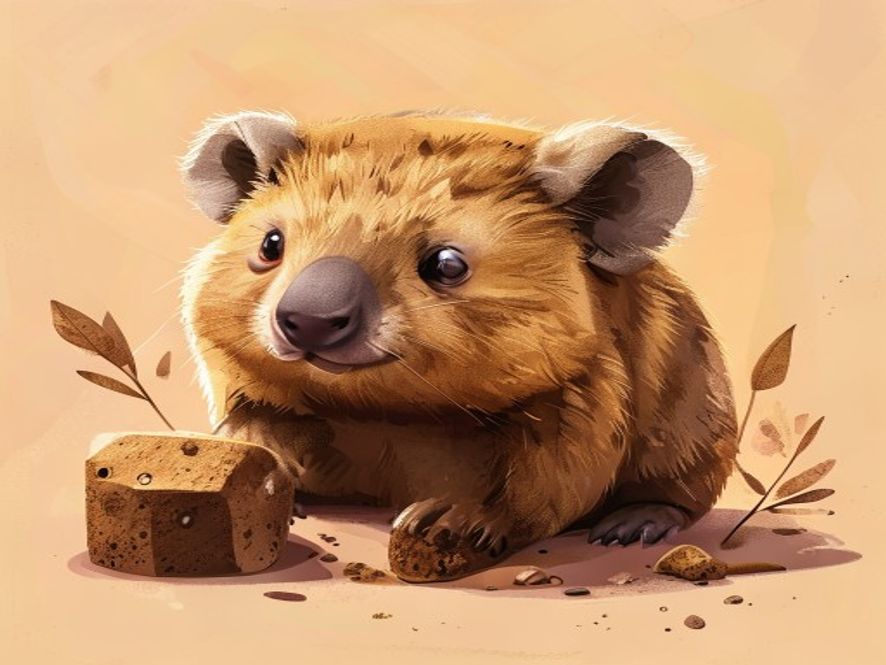
The wombat, a stocky Australian marsupial that looks like a teddy bear crossed with a bulldozer, has a superpower that no other creature on Earth can claim: it produces perfectly cube-shaped droppings. Not oval. Not round. Not vaguely rectangular. Cubes. Nature somehow handed this animal a six-sided geometric achievement that humans only managed with great effort and metal tools.
For years, scientists assumed the wombat must have a square-shaped... exit. They were wrong. In 2019, researchers discovered the real secret: the wombat's intestines have varying elasticity, with stiffer and stretchier sections that together mold the waste into its signature shape during a very slow digestive process that can last up to two weeks.
The reason for all this geometric effort? Territory marking. Wombats stack their little cubes in prominent spots to communicate with other wombats, and the flat sides mean the cubes don't roll away. Evolutionarily speaking, it's a genius move. Aesthetically speaking, it's a lot to unpack.
Scientists are actually studying wombat anatomy to see if the same variable-elasticity principle could inspire new manufacturing techniques. So the next time someone asks where innovation comes from, you can confidently say: occasionally, from a chunky Australian marsupial with an unusually productive digestive system.
More from Weird Facts

Weird Facts
Humans Glow in the Dark, Just Too Faintly to See
Your body is emitting real visible-spectrum photons right now ? not heat, actual light ? but detecting it requires a camera sensitive enough to spot a candle from 10 miles away.

Weird Facts
Polar Bears Are Not Actually White — They're Transparent
Polar bear fur isn't white at all — every single hair is colorless and hollow, like a tiny fiber optic cable, and the skin underneath is completely black.
Weird Facts
T-Rex Never Met a Stegosaurus ? They Missed Each Other by 80 Million Years
The Stegosaurus went extinct roughly 83 million years before T-Rex even existed, making those two famous dinosaurs more separated in time than T-Rex and you.
Weird Facts
Honey Never Expires (And We Mean Never)
Archaeologists cracking open ancient Egyptian tombs have found 3,000-year-old honey still perfectly edible ? turns out honey is basically the immortal snack of the food world.